Tuesday, April 28, 2009

Restless Young Men

“Weren’t the biographies of all great men filled with this same kind of youthful groping, this same kind of rebellion against their fathers and their fathers’ ways?”
--Revolutionary Road


Paul in Paul's Case by Willa Cather.
Frank Wheeler in Revolutionary Road by Richard Yates.
The Real Life Frank Abagnale Jr. (whose story was featured in the book and movie Catch Me If You Can).

All 3 restless young men fighting to escape their fathers' (men they at once admired and resented) curses of mediocrity nearly, or completely, achieve ruin in their own lives.

Cather's Paul steals money from his employer and flees to New York with dreams of a glamorous new life, surrounded by the arts - free of his middle-class existence and the "horrible yellow wallpaper" in his room. Similarly, Frank Abagnale Jr. runs away from home once his father's trouble with the IRS plunges his family into impecuniousness. He, like Paul, lies, cheats, and steals his way to wealth. From what I've read so far, Yates' Frank Wheeler has the same begrudging respect, coupled with disgust, for his father as do Paul and Abagnale - wondering "...who wanted to be a dopey salesman in the first place, acting like a big deal with a briefcase full of boring catalogues, talking about machines all day to a bunch of dumb executives with cigars?"

He as an adolescent also plans a trip - his on a freight train - to begin his own life: "[Frank] spent all his free time in a plan for riding rails to the West Coast. ...he had rehearsed many times the way he would handle himself." He steals his father's hat for his journey and stuffs it with newspapers so that it would fit his small head properly, just as Frank Abagnale Jr. borrowed behaviors and epigrams from his father and used them to his advantage.

These three characters all exhibit a restless, impatient quest toward manhood - but not just any state of manliness - one that would eclipse whatever claims to greatness their fathers' may have laid, taking from them the estimable, leaving behind the execrable.

In Revolutionary Road, it's made clear early in the book that Frank values masculinity, admiring "men who looked like they’d never been boys at all", posing to affect a more distinguished jawline, "the face he'd given himself in the mirror since boyhood and which no photograph had ever achieved", "saunter[ing] manfully" to his father's heavy briefcase as a child and "pretend[ing] it was his own". Abagnale's heroes are pilots, doctors, lawyers, James Bond, Paul's those great men of the stage - and each of these three young men pretended to their goals before they're old enough to achieve them.

Unfortunately, (100 year old spoiler alert!!!) Paul kills himself once he realizes he'll be returned to obscurity, Frank Abagnale Jr. is caught forging checks and imprisoned (though he eventually begins work as an FBI fraud specialist) and I don't yet know what comes of Frank Wheeler. I haven't finished the book.
=)

There seems to be a recurring theme in literature (and movies) of Restless Young Men. Freud's Oedipus Complex, perhaps? Except without the creepy part about marrying one's own mother.... I'll keep a keen eye out as I continue Revolutionary Road.

TRIVIA - Leonardo DiCaprio played both Frank Abagnale Jr. AND Frank Wheeler in the film adaptations of Catch Me If You Can and Revolutionary Road. Coincidence? I think he has that earnest, Restless Young Man Look about him.


"We became drivers and garbage men, so that our children could become doctors and lawyers, so that our grandchildren could become artists and writers, so that our great grandchildren could become models and socialites."

Sunday, March 29, 2009

The Mystery Guest by Grégoire Bouillier Part 1

EDIT: Finished the Book. HOW WRONG COULD I HAVE BEEN????


I'm just starting a new book, The Mystery Guest by Grégoire Bouillier, and I've already some qualms.

So far, what I know of the plot seems promising and the rhythm is pleasant, but there's something ELSE going on....

The Mystery Guest reads like a story being recounted aloud and I read French well enough to have garnered upon comparison that it's the not the fault the English translation. I was afraid that this would be another 'On The Road' - written incidentally as a continuous stream of consciousness with a lax, free-association influenced story structure, each thought or memory triggering the next, the reader frequently taken on amusing tangents along the way (and the tangents are abundant, as are idioms and colloquialisms "as they say"). Boullier's narrative has also in common with Kerouac's its basis in reality; both books blur the line that separates memoir from fiction. But this story has among it's draws, a lyrical rhythm - whereas 'On The Road' bares the telltale mark of certain American fiction: a jumpy cadence.

The rhythm was never the source of my hesitance though. My issue is more with the careless use of tiring and inappropriate idioms:

"...I was fast asleep and at my most vulnerable, my least up to answering the phone, when IN A WORD I was completely incapable of appreciating this miracle for what it was..."

"in a word" <--- This phrase makes no sense here because the following description of the speaker's state of mind is 10 words, rather than 1 word, long. Because this is a translation, there were three possibilities for this lackadaisical error:
  1. It was the doing of the author.
  2. It was the doing of the translator.
  3. It's a device to characterize the emotionally distressed and neurotic narrator.
I was hoping for the third, but unfortunately, it's the translator's fault.

The original reads: "...j'ètais le plus dèmuni et le moins susceptible de rèpondre à son appel et même dans l'incapacitè la plus totale d'en èprouver la miracle." Nowhere does the literal or colloquial equivalent of "in a word" (en un mot/parole) appear. Literally the phrase in question would translate to "yet in the most total inability to experience the miracle."


I'm hesitant to read on from this point because I'm experiencing this book through the lens of someone else's understanding and interpretation of the original text. Audio books, for the same reason, don't appeal to me (being burdened and imposed upon by a stranger's inflections and intonations is no fun). Unfortunately, I can't read French well enough to fully digest, decode, interpret, and analyze an entire book the way I'd like... So I'm forced into a purgatory between languages and will refer to both versions as necessary.

I'll post a full review when I'm done with the book.

Onward I tread.

Monday, March 23, 2009

On Trend Literature + Book Reviews

I've decided not to read anymore trendy, commercial crap like Twilight, so Minion by L.A. Banks is getting returned to the library ASAP. It's a trilogy, and I know once I read the first book, I'll be obligated to read the second and third, so I'm saving myself the trouble of being latched to the series for any period of time by reading none of it. To quote a review from ReadySteadyBook.com, I refuse to read books that are "not so much ‘compelling’ as ‘enslaving’". I'd rather read something of substance if I'm going to take the time. It is wrong to yearn for literary merit????

ANYWHO - The Razor's Edge was a GREAT read. It reminded me of The Picture of Dorian Gray in that Dorian Gray, the character, is a lot like Larry in The Razor's Edge: they're both young, attractive men with no family, of middling social status - charming, charismatic, peculiar. Both cease to age as well, but for very different reasons and in very different ways. The Picture of Dorian Gray's Lord Henry is reminiscent of The Razor's Edge's Elliot Templeton in that they're both obsessed with social status, and strive to remain relevant by being in the favors of those in certain circles and of a certain class. Both are great books that I enjoyed immensely.

The Handmaid's Tale was a surprisingly quick read - and equally disturbing. The matter of the book overshadows the manner in which it was written 100 fold, though it is impressive prose. It tells the story of a dystopian, but not too distant future in which a fundamentalist Christian group takes over America by killing the President and Congress - forcing women into subservient roles, including the eponymous Handmaid, whose sole purpose is reproduction, as most women have been rendered barren by pollution and environmental toxins. THE STORY IS DISMAL! I definitely recommend it to everyone who can read!


I just started The Reader today, but I accidentally read a HUGE plot spoiler online... so the big 'OH NO SHE DIDN'T' of the book isn't going to have as big an impact for me. I won't spill that moment here.... The book is now a movie starring Kate Winslet, and 18-year old German actor David Kross (who is hot! too bad he's so young....). Here's the basic plot: A 15-year old boy is sick on his way home from school and rescued by a woman over twice his age, with whom he then begins an illicit affair - the strangest part is that she makes him read aloud to her. The woman disappears for about 10 years and they run into each other again when he is in law school and she is on trial for war crimes in post WWII Germany.... he's conflicted because she has a huge secret and it's even worse that the heinous acts she committed in the war.

David Kross & Kate Winslet @ The Reader Premier

Best part - David Kross had to learn English for the role.


Can't wait to finish reading this. EDIT: Finished it in about a day. The book has a great plot and full characters, but it's written so clinically.... I'm glad it was short. It felt less like a novel and more like a piece of academic writing or a 200+ page newspaper article. It was very cold, somehow. That said, I did enjoy it and think the way it was written lends itself well to the subjects with which the story dealt. There's a lot of talk of detachment and divorcing oneself from one's actions - and that's exactly how the book reads, so perhaps it was an intentional choice.

I'm looking forward to seeing the movie - mainly because David Kross is HOT!!!! lol


and this is funny: According to the Washington Post, December is National Buy a Book by a Black Author and Give It to Somebody Not Black Month... amazing! AMAZING! As someone who plans to be a novelist (soon?), is in marketing, and is Black - I call 'MARKETING SCHEME' on this one - but it's a good one.

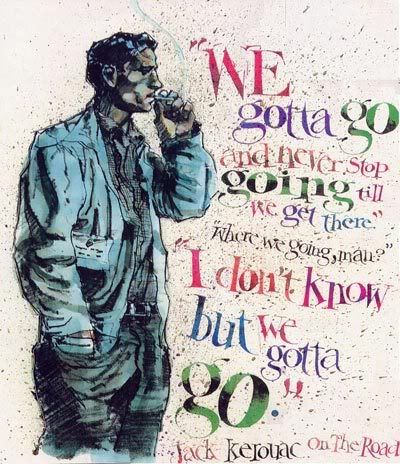
On the Road by Jack Kerouac


I just finished On the Road by Jack Kerouac. I don't think it has EVER taken me this long to finish a book. I've been reading it for over a month.


AND I DIDN'T LOVE IT – AT ALL. But I want to qualify that sentiment.


I didn't feel like aim of this book was a literary one. It's more about documentation – of Kerouac's experiences with Neal Cassady (in the book each are represented by the narrator Sal Paradise and Dean Moriatry respectively) and of the experiences of young people in America at the time – a documentation of the collective consciousness of the country's disillusioned youth. In that way, it's definitely significant historically and culturally.


It spoke in a new voice, with a new cadence, at a new rhythm – fast paced, wild – MAD.

"The only people for me are the mad ones, the ones who are mad to live, mad to talk, mad to be saved, desirous of everything at the same time, the ones who never yawn or say a commonplace thing, but burn, burn, burn, like fabulous yellow roman candles exploding like spiders across the stars and in the middle you see the blue centerlight pop and everybody goes "Awww!"
The above quote pretty much sums up the entire feeling of the book in manner and matter. It's written wildly and it focuses on the uninhibited BEAT generation.

None of this seems revolutionary to us now – but if you think of these people and characters in the context of the buttoned up times of the late 40s and early 50s, it becomes positively sinful and seductive – it becomes a new trend and era. We know that now, but at the time, this book CREATED (or labeled?) an era, a movement – something that could be pointed to, admired, aspired to, and duplicated.


I appreciate that - I get it - but as a standalone piece of literature On the Road wasn't for me. I know that's an unpopular opinion, but had I read this book unaware of its importance and context, I would have honestly regretted reading it (which sounds harsher than the way I intend it – so let me explain).


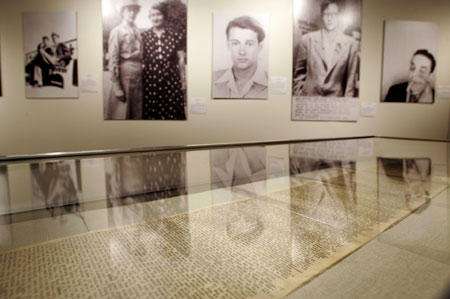
The books I enjoy are written deliberately, carefully – with care given to word choice, syntax, turns of phrase… I love the craft of writing - and the literature I love is artful, though not self-conscious. 'On the Road' was the exact opposite – everything seemed incidental. I felt like the novel's action was captured as it happened (which I know isn't true. The entire book was written during a 3 week caffeine binge on a seamless scroll) and we, the readers, were scrambling (as the narrator Sal does after Dean) to keep up with the momentum of the machine.


Jane Austen comments on the condition from which Kerouac and his narrator seem to suffer in her novel (one of my favorites), Pride and Prejudice; Mr. Bingley says (while at the equivalent of an Austen era kickback):

"My ideas flow so rapidly that I have not time to express them…" to which Mr. Darcy replies, "The indirect boast; for you are really proud of your defects in writing, because you consider them as proceeding from a rapidity of thought and carelessness of execution, which, if not estimable, you think at least highly interesting. The power of doing anything with quickness is always prized much by the possessor, and often without any attention to the imperfection of the performance."

That pretty much sums up how I feel about 'On the Road'. Jack Kerouac himself is quoted as having said, "My fault, my failure, is not in the passions I have, but in my lack of control of them".

But it all makes perfect sense (so was it deliberate?). The characters in the book are spontaneous, haphazard and MAD, always in pursuit and on the move (on the road…) – so if this book was written with too much structure, too much order or attention to consequence it would have felt terribly, terribly wrong.


So I can't say I HATED On the Road - it just isn't my kind of novel. I'm only one person and these just happen to be my reading preferences. I've wanted to read this book for a while. Now I have. Back to regular programming. Up next are 'The Mystery Guest', 'Revolutionary Road', and 'The Age of Innocence'.


Favorite quotes (that weren't already mentioned):


"I like too many things and get all confused and hung-up running from one falling star to another till i drop. This is the night, what it does to you. I had nothing to offer anybody except my own confusion."


"Everything happened."

"He could hardly get a word out, he was so excited with life."

"He's never hung up, he goes every direction, he lets it all out, he know time, he has nothing to do but rock back and forth. Man, he's the end!"


yea... the whole book is like that.