Tuesday, April 21, 2009

Blackberry-Picking by Seamus Heaney + Divinity in Literature

I've already written about my favorite and second favorite poems on this blog; Blackberry Picking by Seamus Heaney is my third. In this post I'll explain why.

I grew up in church (African-American, Christian, Non-denominational) and have had fleeting spats of full devotion and engagement, but tend to feel a bit divorced from it all. I'm just as interested in the Bible as literature, apart from its larger religious implications, as I am in reading it as the literal WORD OF GOD (though I read it for guidance, instruction, and encouragement more than I do for verifying literary allusions).

Because of my exposure from such an early age, I tend to find (or do I seek?) the Biblical, the Divine in all I read. For an entire semester of high school AP LIT, I analyzed every assigned book, poem, essay, etc through a Biblical lens. All I could see in Beloved was Morrison's allusion to the Four Horsemen of the Apocalypse... and any passing reference to parable or scripture in any work became, to me, the author's overarching Biblical theme. This tendency was at first impressive (sometimes offensive!) to my teacher and peers, and quickly became pedantic and tiresome - but I was 17 at the time. I'm 22 now... much older, much wiser.
:\ (if only!)


Sometime during that (stained glass?) window, I read Blackberry-Picking by Seamus Heaney. Rereading it now, I don't think my initial analysis was too off the mark, or clouded by the divine fog in which I then found myself.

Blackberry-picking

Late August, given heavy rain and sun
For a full week, the blackberries would ripen.
At first, just one, a glossy purple clot
Among others, red, green, hard as a knot.
You ate that first one and its flesh was sweet
Like thickened wine: summer's blood was in it
Leaving stains upon the tongue and lust for
Picking. Then red ones inked up and that hunger
Sent us out with milk cans, pea tins, jam-pots
Where briars scratched and wet grass bleached our boots.
Round hayfields, cornfields and potato-drills
We trekked and picked until the cans were full,
Until the tinkling bottom had been covered
With green ones, and on top big dark blobs burned
Like a plate of eyes. Our hands were peppered
With thorn pricks, our palms sticky as Bluebeard's.

We hoarded the fresh berries in the byre.
But when the bath was filled we found a fur,
A rat-grey fungus, glutting on our cache.
The juice was stinking too. Once off the bush
The fruit fermented, the sweet flesh would turn sour.
I always felt like crying. It wasn't fair
That all the lovely canfuls smelt of rot.
Each year I hoped they'd keep, knew they would not.

Seamus Heaney


The literary critic J.V. Cunningham noted "How difficult it is to write in praise!". Well, here's my taking a shot.

Heaney uses contrasting images of divinity - first allusions to Christ, communion, and the crucifixion associated with the action of picking the blackberries - then to the Biblically defined sins of gluttony, lust, and greed (peppered through the first stanza and dominating the second) - to illuminate the emotions associated with picking and eating blackberries, which are in turn used to parallel the human tendency to unwittingly self-destruct, to Fall from Grace - even when intentions are good.

The conscious lack of agents in lines 1 & 2 ("...given heavy rain and sun/ for a full week, the blackberries would ripen,") suggests the influence of a higher power. The blackberries do not ripen themselves and "would ripen" only "given heavy rain and sun" - but "GIVEN" by WHOM? Sacred diction in lines 5 & 6 elevate the speaker's experience of eating blackberries to the equivalent of taking communion - "it's flesh was sweet/like thickened wine: summer's blood was in it." In aligning the act of partaking of the body or "flesh" and blood of Christ to biting into the wine-producing blackberries, Heaney cements this act as a religious experience.

The word "lust" is slipped in the poem to appear as an afterthought in a sentence that progresses from concrete to abstract in lines 7-9. The sentence that includes "...leaving stains upon the tongue /and a lust for picking" establishes "stains" and "lust" as parallels - both are nouns, but a stain is tangible, can be physically perceived; lust is not, cannot. "Hunger" is made the agent of the verb "sent" in line 8 - labeling hunger a driving force, capable of inciting action. "Lust" and "hunger" as used here are in opposition to the tone of the first stanza, but serve to hint at darker events to come.

In lines 10-12 the speaker's trip to crate the berries is likened to a religious pilgrimage or Herculean task, one to be "round hayfields, cornfields, and potato-drills... trekked", one that would "bleach [their] boots" - recalling Biblically scarlet sins being "washed white as snow" - as is the mission of most pilgrimages. The trek was only complete once their "cans were full"; here the transition into the second stanza's theme of gluttony begins.

The speaker and his companion's hands being "peppered with thorn pricks" is a stark allusion to Crucifixion of Christ. That the blackberries with their "big dark blobs burned/ Like a plate of eyes" are watching the pickers as they red-handedly stock them to be hauled away is intentional - and prepares the reader for the guilty disappointment of the next lines.

The greed, hunger, and lust merely hinted at in the first stanza are consummated in lines 15-17. They "hoarded, were "glutting" and as a consequence, a punishment, the once "sweet flesh.. turned sour" - the forbidden fruit from "the bush... fermented"... all was tarnished - the imagery is nearly sacrilegious. As with Adam and Even in the Biblical Garden of Eden, the speaker's innocence was purged and replaced with an undesirable knowledge - that once off the bush, a parallel to the fruit picked from the Tree of Knowledge of Good and Evil, the berries they greedily hoarded and "hoped would keep", they "knew would not". The evil existed in the speaker's gluttony, which caused the surplus to rot - the knowledge of which ruined the joy of picking blueberries "every year" - yet this greed persisted annually.

Thus is human nature - and the masterful ability of Seamus Heaney to describe that tragic nature so beautifully.


It's actually not at all difficult to write in praise when you've got a poem such as this for inspiration.

I will eventually get to writing about Gus von A (Death in Venice) as a fallen dandy (as defined by dandyism.net) and the conclusion of my first installment of Hip Hop as Literature - I'm just not sure when.

Wednesday, April 15, 2009

Sharon Olds - Rite of Passage + Children's Perspectives

My second favorite poem is Rite of Passage by Sharon Olds. I love literature that deals with children's perceptions of themselves, each other and the world - and this poem touches on that through the eyes of a parent reluctant to see his or her son grow up.

Janiyah & Sinclair

I babysit often(!) and my cousin Janiyah and her friend Sinclair never cease to amaze me with their acute observations and talents for making even the simplest things profound and expressing their wonder pithily. Maybe it's because I don't remember how my mind worked or how I saw the world as a child (at the ripe old age of 22) - or how words and letters looked before I learned to read, or what purposes I ascribed to machines before I learned their use.


Literature that believably taps that pool of innocence captures me every time. Some favorites include First Confession by Frank O'Connor, The Chimney Sweeper by William Blake (both versions from Songs of Innocence and Experience), and though people HEAVILY criticize it - The Boy in the Striped Pyjamas by John Boyne.


*spoiler alert*

Without my making any claims about its historical accuracy or feasibility, its morality, or perceived exploitation of the fable form to push its agenda, The Boy in the Striped Pyjamas told the story of a boy's life in Nazi German betraying few signs of its adult author (though I realize a 9-year old child couldn't have written this book). It captured the way children internalize and regurgitate words and phrases they hear, using them in and out of context - the narrator Bruno repeatedly calling his sister The Hopeless Case after hearing the phrase used once, referring to Auschwitz as ‘Out-With’ and Hitler (the Führer) as The Fury.

*end spoiler alert*

Subject matter aside, its narrator was not unlike Ralphie from the movie A Christmas Story - precocious, prone to hyperbole and bouts of waking fantasy, with a tendency to believe that everyone's against him.... It's a success in storytelling.

All that brings me to Rite of Passage, which is not told from a child's POV, but manages to accurately convey the way children see themselves in relation to each other - and how adults perceive these miniature showdowns... I have a younger brother (I'm almost 8 years older than him) and I've seen what Olds describes in her poem IN ACTION.

Rite of Passage

As the guests arrive at our son’s party
they gather in the living room—
short men, men in first grade
with smooth jaws and chins.
Hands in pockets, they stand around
jostling, jockeying for place, small fights
breaking out and calming. One says to another
How old are you? —Six. —I’m seven. —So?
They eye each other, seeing themselves
tiny in the other’s pupils. They clear their
throats a lot, a room of small bankers,
they fold their arms and frown. I could beat you
up, a seven says to a six,
the midnight cake, round and heavy as a
turret behind them on the table. My son,
freckles like specks of nutmeg on his cheeks,
chest narrow as the balsa keel of a
model boat, long hands
cool and thin as the day they guided him
out of me, speaks up as a host
for the sake of the group.
We could easily kill a two-year-old,
he says in his clear voice. The other
men agree, they clear their throats
like Generals, they relax and get down to
playing war, celebrating my son’s life.

The images of gathering little men "tiny in each other's pupils" "jostling, jockeying for place" remind me of mammal cubs at a watering hole, instinctually play-fighting to learn the survival skills they'll need later in life, the fights "breaking and calming" like undulating waves - as is the fickle nature of childhood grudges.... The speaker's son banning the small men together against a common and weaker enemy, "a two year old", only relayed to the reader through the speakers eyes...

This poem is perfect.

There's so much to love here and I could write more BUT I have a traffic tracker that lets me know what people are Googling to find their way here and a LOT OF YOU are cheating on papers.... TISK TISK! No Freebies!

Anywho - I'm reading Revolutionary Road now + coming up there'll be more on 'Hip Hop as Literature' and Death in Venice (Gus von A as a fallen dandy).

Monday, March 23, 2009

My First Poem For You by Kim Addonizio

This is by far one of my favorite poems. I could go on and on about it - but read it first:

I like to touch your tattoos in complete
Darkness, when I can’t see them. I’m sure of
Where they are, know by heart the neat
Lines of lightning pulsing just above
Your nipple, can find, as if by instinct, the blue
Swirls of water on your shoulder where a serpent
Twists, facing a dragon. When I pull you
To me, taking you until we’re spent
And quiet on the sheets, I love to kiss
The pictures on your skin. They’ll last until
You’re seared to ashes; whatever persists
or turns to pain between us, they will still
be there. Such permanence is terrifying.
So I touch them in the dark, but touch them, trying.


See? What did I tell you? AWESOME!

'My First Poem For You' is pretty much a sonnet: rhyme scheme? check! 14 lines? check! the meter fluctuates, but for all intents and purposes, this is a structurally sound sonnet - down to the final reflective couplet.

Kim Addonizio is a TRUE talent; this piece is so precise, but reads so casually and intimately (sensually???) and with such fluidity, you'd never notice how formally it's written on a first reading - and that takes some SERIOUS skill to pull off. But it all works because the structure of the poem is in such direct opposition to the conversational tone and the subject matter.

The speaker obviously has some complex feelings about whoever this "you" character is; she freaks out about the permanency of his tattoos, which she only appreciates and explores in the dark - which I read as her ACTUALLY freaking out about the increasingly serious nature of their relationship. DEEEEEEEEP!

And if you break it down by sentences, its all "I like," "I can't," "I'm sure," "I pull," "I love"... bla bla yadda yadda - and then out of NOWHERE it's not about the speaker any more in the last lines and she finally hits us with "permanence is terrifying" (say whaaaaaaaa?). The last word, "trying" leaves me reeling everytime - she leaves the verb unsatisfied like that - just like her ongoing struggle with her feelings this "you"..... which makes sense because this is the "FIRST" poem for whoever this person is - and probably not the last.

I.
LOVE.
THIS.
POEM.

I'm not going to write a PAPER about this poem on my blog - but there are a million reasons to love this poem... above are a few.

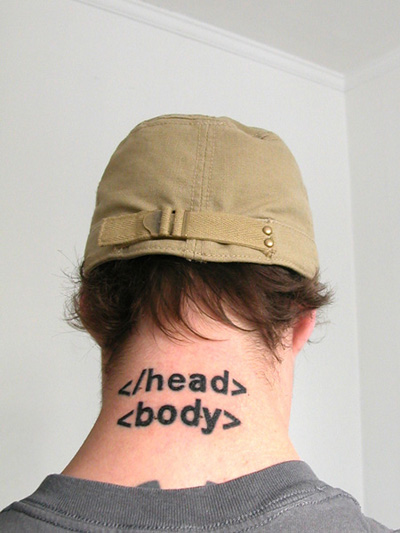
nothing like a good nerd tattoo.